Digging the Past
July 12, 2019
What happened in the past? As a history student, I always have this question in mind, no matter when I am reading manuscripts, writing papers, traveling, or just passing through a historical alley. Now I have a new timing to think about the past – when I am working in the trench in our archaeological site in Armenia.
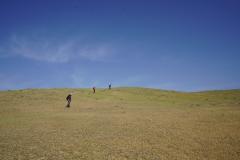
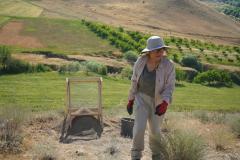
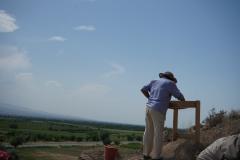
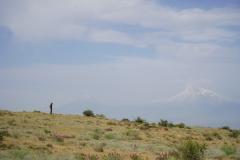
Our team- composed of archaeologists, architects, computer scientists, and historians- has come to Armenia to start an archaeological project this summer. For the past months, we spent our time in Vedi, a town south to Yerevan in the Ararat Plain. We mainly excavated in Vedi Fortress locates near the village Dashtakar, where there were traces of medieval and possibly earlier settlements. We found the remains of fortress walls, pottery fragments, bones, carbons and more.
While sweat burnt my eyes, dusk covered my face, and bugs ran into my shoes, my mind drifted to thousands of years ago. When I was identifying a pottery fragment in the sieve, I imagined what Bronze Age people put into the potteries; when I was surprised by a large skeleton of an animal head, I imagined how they get their food; when I brushed the stone wall, I imagined whom they are defending against. This provides me a unique perspective to think about the past which is quite dissimilar from that of history. When I am reading historical sources – especially those in first-person – I always immerse myself into the words, trying to understand the past events through the narration of the writer. It allows me to resonate the emotions of the insiders, like looking into the distant past through the writer’s lens, though sometimes the lens is blurry or my view is blocked. I am led by local guides into the trail to the antiquity, but I am not able to always follow their steps and sometimes I get lost. I enjoy this adventure of exploring the past a lot through the warmth of words. Archaeology is different – it is more like completing a jigsaw. We have to determine the location of the trenches and decide where to open new contexts according to our new findings. We make hypothesizes of the usage, the direction of extension, and the period of time of the space. Our predictions range from the interactions of the surrounding settlements to the interactions of two walls. We find the puzzle pieces and put them together – the physical work is tedious and tiring but the mind game is interesting. It leaves more space for imagination for me to reconstruct the past. This approach, in return, stimulates and activates my mind more to think of the picture that was not described by the writers based on the evidence provided in the text when I am doing history.
Although history and archaeology have a distinct methodology, they both lead to the same end – the past. But how is this past related to the current society? Or more straightforwardly, why is the past important? This question was recurring in my mind since I have thought about pursuing a career in the field of history. Our team tried to answer this question during our office time, during our casual conversation, and during our meal discussion based on readings. Every team member offered different answers, affected by their background and discipline, and I am very pleased and inspired by every answer. The question was further explained by my research on the historical mapping of Chinese travelers to Armenia. This project of mapping historical travelers to Armenia, especially the Ararat Region, was initiated by Dr. Elvan Cobb, and I found the process very intriguing. Before I started the research, the persisting discourse about China's Belt and Road Initiative in Armenia and their friendship since “time immemorial” was annoying to me and more of a platitude than historical fact. However, as I browsed through Chinese traveler accounts and imperial records, it turned out that there possibly were Chinese officials passing through Armenia since the Tang Dynasty. Although the formal official exchange was not shown, Armenia seemed to play a certain role in the trade of local commodities like herbs and Chinese silk in the Silk Road. While I am delighted that my historical research can correspond to the current political and diplomatic discourse, a question remains – can Armenia-China relation since ancient time continue to be based on equality and mutual benefits? The invasion and tyrannical rule of the Mongol Dynasty over Armenia brought lasting damage to Armenia – will history repeats itself and imperialism, in any form, bring misery again in the future?
In another circumstance, I do hope that history will repeat. Since mid-June, waves of protest against the extradition law in Hong Kong caught our mind and emotions in Vedi. Our team discussed the incidents and expand our conversations to the political situations in Hong Kong, the US, China, Turkey, and Armenia. The idea I gained from our engaging and intense conversations is that in the seemingly ‘democratic’ societies there are political unfairness and oppression, and in the allegedly ‘undemocratic’ societies, there are improvements and changes. I am particularly amazed to learn the revolution happened in Armenia last year. Their successful non-violent protest against the corrupted government is an encouraging example for Hong Kong, though the situations are quite different. In Hong Kong, as weeks went by, the focus of the protests went beyond the bill itself and became an explosion of public discontent to the SAR and PRC government. A prominent theme is fighting for liberty - but what is liberty? While holding a brush or a trowel under the scorching sun, I was thinking about the Roman plebian protests, the Great French Revolution and the Qing 1911 Revolution. They were all in the name of liberty, but their definition of liberty, their means of achieving liberty, and their result of pursuing liberty were all very different. What kind of liberty are Hong Kong people fighting for? My very limited knowledge is incapable to make a close guess, not to mention answer, this difficult question, but perhaps there are hints hidden in history waiting for me to find out.
Thank you for listening to the mumbling of a historian-in-training.
This page has paths:
- 2019 Field Season Peter Cobb