2020-Blog02-Img02
1 media/2020-Blog02-Img02_thumb.jpg 2020-08-29T06:44:31+00:00 Peter Cobb 29b5ca8528741ed24b5845551abe7867c123652d 3 1 plain 2020-08-29T06:44:31+00:00 Peter Cobb 29b5ca8528741ed24b5845551abe7867c123652dThis page is referenced by:
-
1
media/2020-Blog02-Img01.jpg
2020-08-24T10:38:03+00:00
Dating Pottery from its Decoration
18
plain
2020-09-06T00:34:06+00:00
by Brian Wong, University of Hong Kong, Faculty of Arts Undergraduate Student
September 6, 2020
There were thousands of pottery fragments excavated from the Vedi Fortress last summer. Dating artifacts is extremely important for archeological studies, as we may recognise and understand the living styles, habits, as well as beliefs and technologies of people in the past through the stuff they used, for instance, pottery. How can we date an artifact? Inspired by the articles I read before, like Excavation at Maisyan (2014) written by Levon Petrosyan and co-authors, I was interested in dating the pottery discovered at the Vedi Fortress by comparing its decoration with other pottery found at other sites in Armenia.Different kinds of decoration can be seen on the findings from the Vedi Fortress, such as dots, straight belts, curved lines and seed-like ornament. I focused on the seed-like ornament, and chose 22 examples from two trenches (478130.4419430, 478020.4419550). It is interesting to do research on seed-like ornaments, those appeared on the examples, and were added to the surface in different ways, incised or impressed; and decorated with other ornaments, like straight lines and curved belts; or displayed in various forms, such as symmetrically, located on the protuberant part or at the edges of a fragment.
In order to compare the pottery discovered at the Vedi Fortress with the similar pottery from other sites in Armenia, I have created a database in MS Access. Databases are a fascinating tool for comparing similar pottery. The database that I have created was formed in two parts: a main-form for introducing information of the pottery found at the Vedi fortress, and a sub-form for displaying information of the similar pottery. The types of information shown in the main and sub-forms are similar, including the inventory number, site, trench, era, and drawing or photograph of the pottery. I will also describe the color and decoration of the pottery excavated at the Vedi Fortress.One thing that I would like to mention is the default view of the sub-form in Access. There are several default views that we can choose, like “single form”, “continuous form” and “datasheet”. Prior to creating this database, I had completed six pottery databases, and I usually chose “single form” for main-forms, and “datasheet” for subforms. However, the main purpose of this database is to compare the pottery at the Vedi Fortress with similar pottery from other sites. Therefore, it is important to show the drawings or photographs of similar pottery, and the cells of the datasheet will be too small for it. Consequently, I chose “continuous form” for the default view of the sub-form.
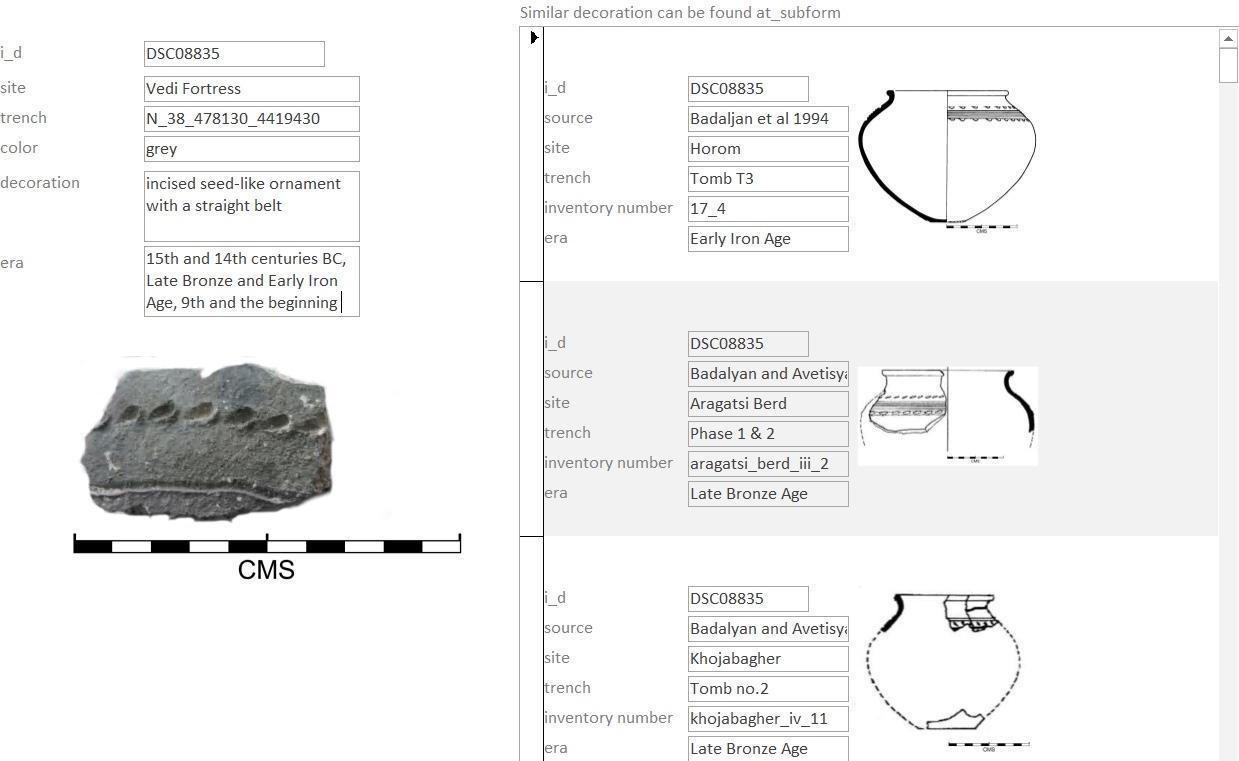
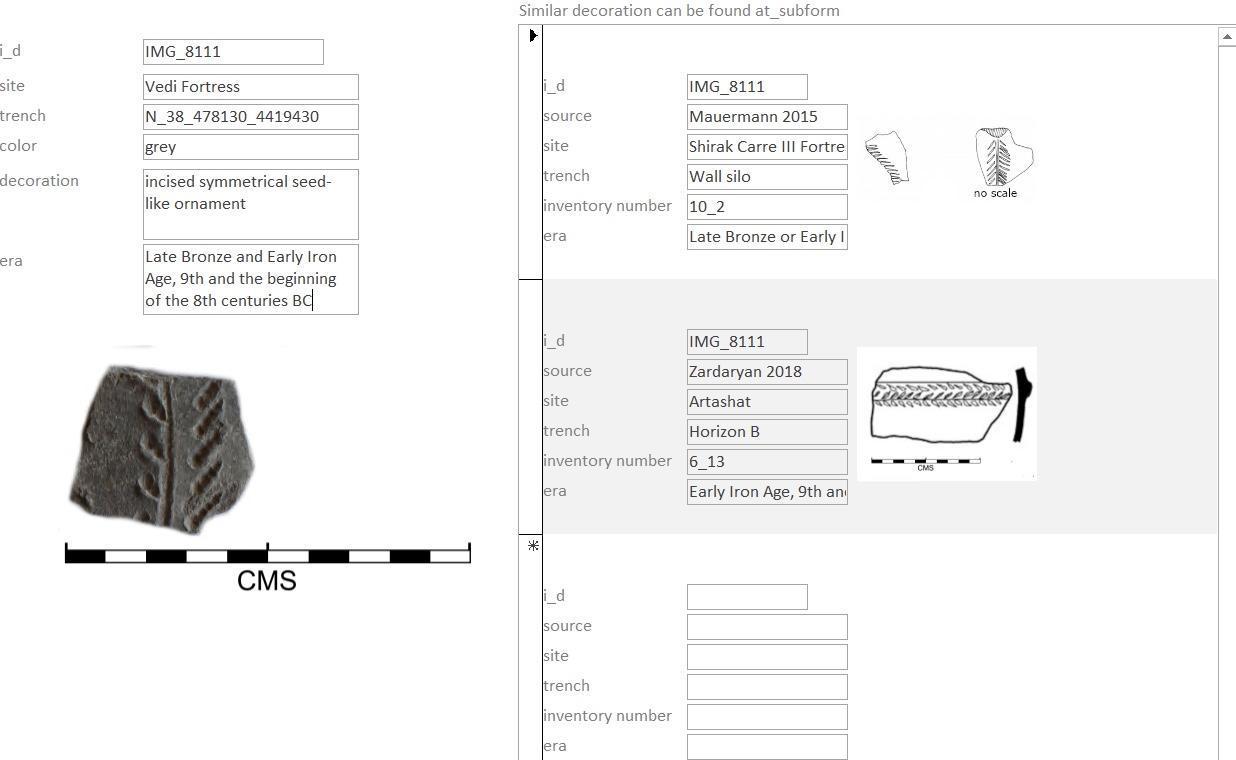
Below are two examples of showing data of pottery from its decoration by using a database.
Researchers can quickly compare pottery that have similar shape, color and decoration by using databases, and this is hugely beneficial to the dating of pottery. It is only the starting point of dating the pottery excavated at the Vedi Fortress last year. It will be great if we can visit the site, and discover more pottery in the near future!
The first example is excavated from the Vedi Fortress trench 478130.4419430. It is grey and decorated with incised seed-like ornament and a straight belt. Similar decorations can be found at Horom Tomb T3 (17_4), dated to the Early Iron Age (Badaljan et al., 1994); Aragatsi Berd Phase 1 and 2 (aragatsi_berd_iii_2), Khojabagher Tomb no.2 (khojabagher_iv_11), dated to the Late Bronze Age (Badalyan and Avetisyan, 2007); another shred from the Vedi Fortress trench 478130.4419430, Kanagegh Tomb 6 (6_3), dated to the 15th and 14th centuries BC (Melikyan and Tumanyan, 2019); and Artashat Horizon B (6_10), dated to the Early Iron Age, as well as the 9th and the beginning of the 8th centuries BC (Zardaryan, 2018). Therefore, I believe this first Vedi Fortress example belongs to the 15th and 14th centuries BC, Late Bronze to Early Iron Age, or the 9th and the beginning of the 8th centuries BC.
The second example was found at Vedi Fortress trench 478130.4419430. It is grey and decorated with incised symmetrical seed-like ornament. Similar decorations can be found at Shirak Carre III wall silo (10_2), dated to the Late Bronze or early iron Age (Mauermann, 2015); and Artashat Horizon B (6_13), dated to the 9th and the beginning of the 8th centuries BC (Zardaryan, 2018). Therefore, I believe this second example also belongs to the Late Bronze or the Early Iron Age, or the 9th and the beginning of the 8th centuries BC.References:
- Badaljan, R.S. et al., “Preliminary Report on the 1992 Excavations at Horom, Armenia”, Iran, 31 (1993): 1-24.
- Badalyan, R.S. and Avetisyan, P.S. Bronze and Early Iron Age Archaeological Sites in Armenia. Oxford: Archaeopress, 2007.
- Mauermann, D., “Azatan - An Iron Age Fortification and Settlement in Shirak/ Armenia”, in International Symposium in East Anatolia - South Caucasus Cultures Proceedings II (edited Isikli, M. et al.). Newcastle upon Tyne: Cambridge Scholars Publishing, 2015, 1-23.
- Melikyan, V. and Tumanyan G., “Kurgans with auxiliary cists, externally attached to the cromlech in Armenia”, Aramazd, 13, no. 2 (2019): 56-68.
- Petrosyan et al., “Excavation at Maisyan (2014)”, Aramazd, 13, no. 2 (2019): 120-135.
- Zardaryan, Mkrtich H., “The Early Iron Age settlement of Artashat and problems of chrono-topography of the site (pre-classical period)”, Aramazd, 12, no.2 (2018): 105-145.
- Badaljan, R.S. et al., “Preliminary Report on the 1992 Excavations at Horom, Armenia”, Iran, 31 (1993): 1-24.